ESG
Sustainability Policy
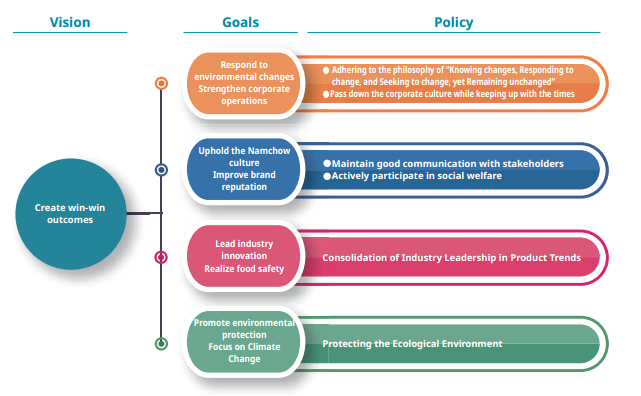
Namchow Sustainability Policy
Under the leadership of Chairman Fei-Lung Chen, Namchow Group has made significant innovations that extend the Group’s strong legacy and conform to its core value: “People First.” This philosophy is what constantly motivates Namchow Group to share the goals and values of society, contribute to the benefit of consumers and mankind, and envision win-win solutions between customers, consumers, industry participants, society, and the environment.
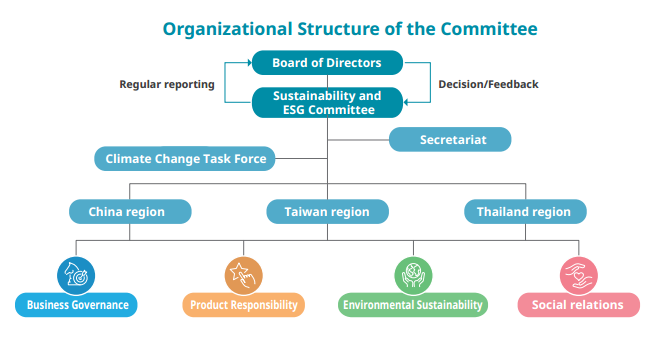
Sustainability and ESG Committee
Namchow Group has established a committee responsible for promoting the Group’s sustainable development policy. The Board of Directors is the highest supervisory unit for this organization. The chairperson of the committee is the General Manager of Namchow. The committee oversees several regional sub-committees in Mainland China, Taiwan, and Thailand. Each sub-committee is divided into four sections, namely: business governance, product responsibility, social relations, and environmental sustainability. Each sub-committee is headed by an assistant vice president, director, or higher-ranking executive. Responsibilities include devising policy responses and action plans for relevant issues
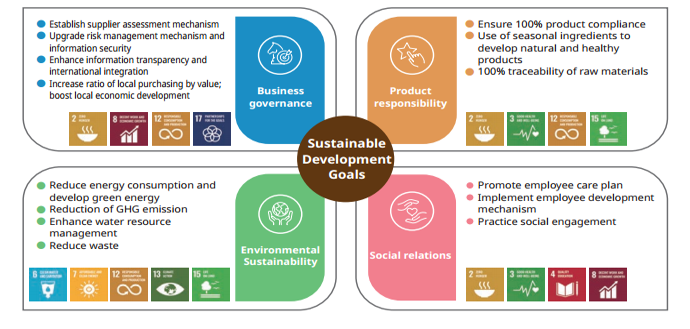
Sustainable Development Goals of Namchow Group
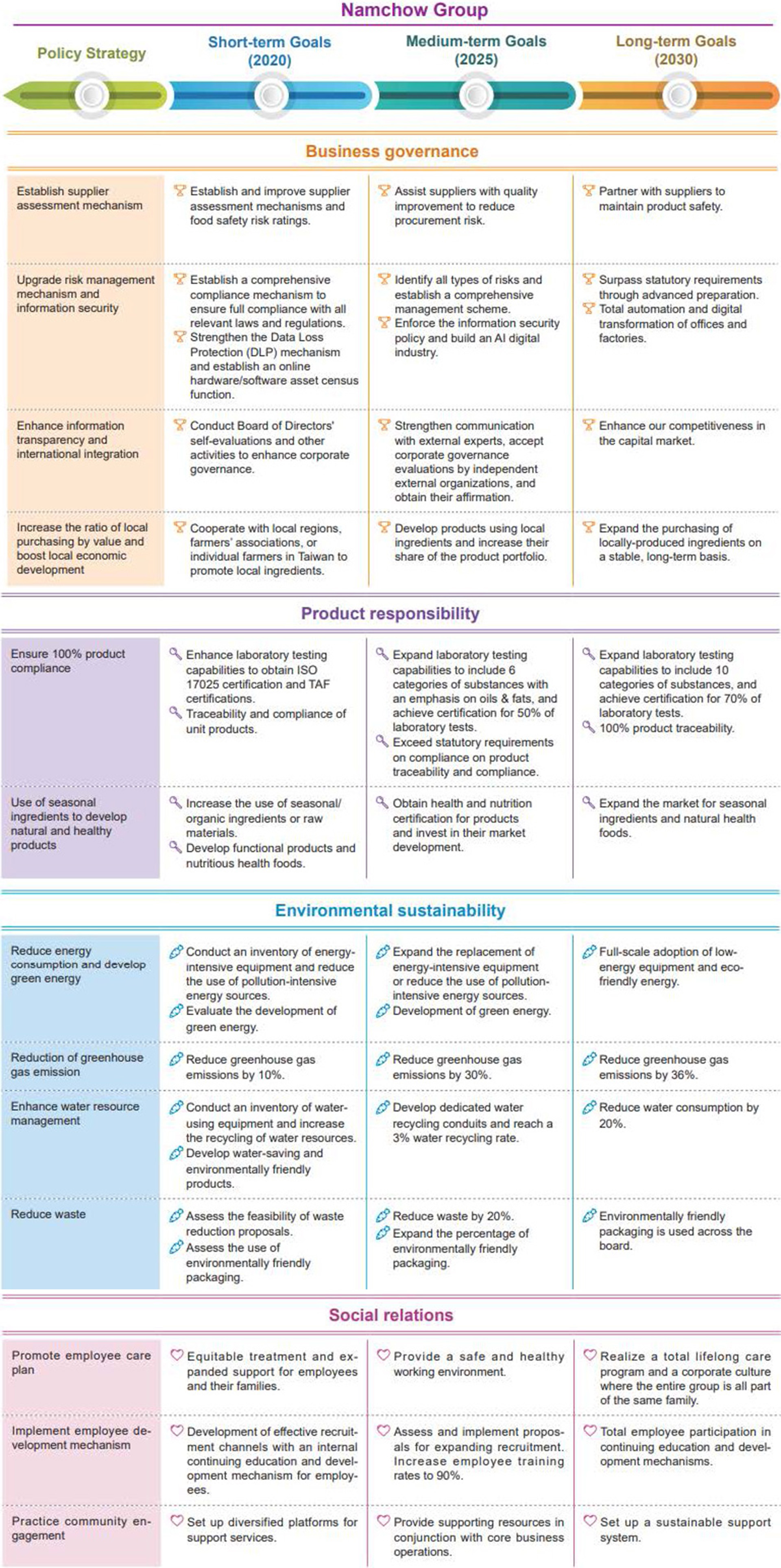
In the UN Summit in 2015, the UN announced Transforming our World: The 2030 Agenda for Sustainable Development as In the UN Summit in 2015, the UN announced Transforming our World: The 2030 Agenda for Sustainable Development as a guiding principle for countries around the world. This principle has expanded from purely pursuing economic growth in the past to the three major aspects of economy, society, and environment. Only under the premise that the society and the environment are abundant in resources and sustainable will it be meaningful for enterprises to pursues sustainable economic development.
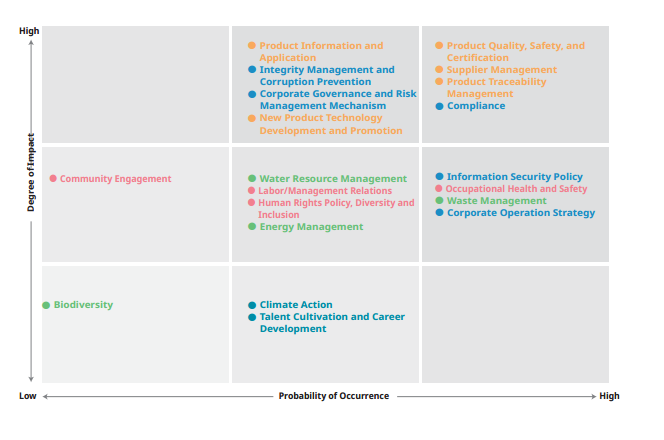
2024 Sustainability Issue Matrix
Namchow Group values the voices of diverse stakeholders, understands and identifies their key concerns, and responds to their expectations. Through surveys, we assess the issues prioritized by primary stakeholders and their impact on economic, environmental, and social dimensions, thereby identifying preliminary material topics.
Based on the previous year's identification results and considering the latest trends and issues, our ESG Working Group has screened 16 material sustainability issues this year. This process incorporates feedback from stakeholders and factors such as operational risks to the company, addressing the economic, environmental, and social sustainability trends and risk concerns raised by the aforementioned stakeholders.